
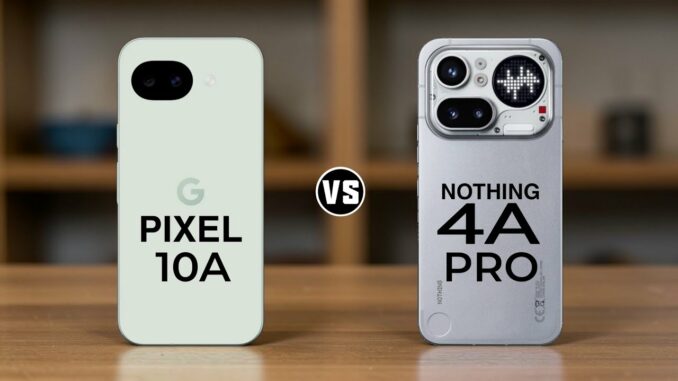

After months of speculation and leaks, both Nothing Phone (4a) Pro and Google Pixel 10a have finally been unveiled. Interestingly, Nothing decided not to release a flagship device in 2026, allowing the Phone (4a) Pro to step forward as the brand’s standout option in the midrange category. Meanwhile, Google continues its popular A-series lineup with the Pixel 10a.
Both phones start at the same price—around $499—making the choice even more interesting. If you’re trying to decide between these two midrange contenders, this comparison explores their design, display, camera capabilities, performance, and software features to help you pick the right device.
In This Content
Design
The Nothing Phone (4a) Pro features a premium aluminum frame with flat edges and a slim profile measuring just 7.95 mm, making it the thinnest full-metal device Nothing has produced so far. In comparison, the Pixel 10a is slightly thicker at 9 mm, though it still maintains a comfortable grip.
Nothing has refined its design language this year. Unlike the unusual camera layout of the previous model, the new phone adopts a cleaner and more symmetrical look. One of the most notable additions is the Glyph Matrix display, previously seen on the flagship Nothing Phone 3. This feature lets users check information such as the time or timers without unlocking the phone, and it can also display custom notification animations for selected contacts.
The camera bump on the Phone (4a) Pro reveals part of the device’s internal design while housing the triple-camera system and the Glyph Matrix screen.
By contrast, the Pixel 10a takes a minimalist approach with a flat rear panel. When placed next to phones with larger camera bumps—like the Google Pixel 10—the Pixel’s smooth back panel feels refreshingly simple and stable on a desk.
Color options also differ:
Pixel 10a colors:
-
Lavender
-
Berry
-
Fog
-
Obsidian
Nothing Phone (4a) Pro colors:
-
Black
-
Silver
-
Metallic Pink
Display
Display quality is another important factor in this comparison.
The Pixel 10a features a 6.3-inch Actua OLED display with a resolution of 1080 × 2424, delivering around 422 PPI and a refresh rate that ranges from 60 Hz to 120 Hz. Its 3,000-nit peak brightness makes it easy to view outdoors in strong sunlight.
However, the Nothing Phone (4a) Pro pushes display performance even further. It offers a larger 6.83-inch AMOLED panel with a 1260 × 2800 resolution, 450 PPI, and a 144 Hz adaptive refresh rate.
Brightness is where Nothing truly stands out, with a claimed 5,000-nit peak brightness, along with 2,500 Hz touch sampling during gaming sessions.
Compared with entry-level devices like the Apple iPhone 17e, both phones offer noticeably smoother scrolling and improved responsiveness. Once users experience high refresh rates like 120 Hz or 144 Hz, returning to standard 60 Hz displays can feel noticeably less fluid.
Camera
Smartphone cameras continue to evolve with larger sensors and advanced optics, often requiring larger camera modules.
The Pixel 10a keeps a relatively modest camera setup:
-
48 MP main camera
-
13 MP ultrawide lens
-
13 MP front-facing camera
Although the hardware remains similar to previous models, Google’s image processing ensures photos still look excellent, especially for everyday photography and social media sharing.
The Nothing Phone (4a) Pro, on the other hand, introduces a more ambitious camera system:
-
Sony main camera with optical image stabilization (OIS)
-
50 MP periscope telephoto lens with 3.5× optical zoom
-
Sony ultrawide camera
-
32 MP selfie camera
The inclusion of a periscope telephoto lens is particularly impressive in the midrange segment, allowing the device to reach up to 140× digital zoom—a rare feature at this price level.
Powered by TrueLens Engine 4, the camera system supports Ultra XDR photography and 4K Ultra XDR video recording, producing vibrant colors, strong contrast, and improved highlight detail.
Performance
The Pixel 10a continues using the Google Tensor G4 processor found in the previous model. This marks a departure from Google’s earlier approach of introducing the newest Tensor chip in each A-series device.
While the Tensor G4 still handles everyday tasks smoothly—including messaging, browsing, and casual gaming—it is not the most powerful option available in this price range.
The Nothing Phone (4a) Pro steps ahead in performance with the Qualcomm Snapdragon 7 Gen 4 processor. Compared with the Qualcomm Snapdragon 7s Gen 3 used in the earlier model, this new chip delivers:
-
27% faster CPU performance
-
30% improved graphics
-
Enhanced AI capabilities
For demanding games or heavy multitasking, the Snapdragon chip offers noticeable advantages. However, for everyday tasks, both phones perform reliably.
Software and AI Features
The Nothing Phone (4a) Pro runs Nothing OS 4.1, built on Android 16. This interface focuses on customization and simplicity, introducing features like:
-
Resizable Quick Settings
-
Customizable lock screens
-
Improved live notifications
-
Faster app launching
Nothing promises three major Android updates along with six years of security updates.
The Pixel 10a emphasizes artificial intelligence and smart photography tools. Some of its AI features include:
-
Camera Coach, which helps users improve framing and composition
-
Auto Best Take, which merges multiple photos to create the best possible group shot
These AI tools highlight Google’s strength in computational photography and intelligent software.
Final Verdict
Both phones deliver excellent value in the midrange category, but they cater to slightly different preferences.
Choose the Nothing Phone (4a) Pro if you want:
-
A unique and eye-catching design
-
A larger and brighter display
-
A versatile camera system with telephoto zoom
-
Stronger performance for gaming and heavy apps
Choose the Google Pixel 10a if you prefer:
-
A clean, minimalist design
-
A simple and reliable Android experience
-
Google’s powerful camera processing and AI tools
-
Seamless integration with Google services
Overall, the Nothing Phone (4a) Pro offers more hardware features for the same price, which may appeal to users focused on specifications and innovation. However, the Pixel 10a remains a solid choice for those who value software simplicity and dependable photography.
Either way, both devices provide a strong midrange smartphone experience.