
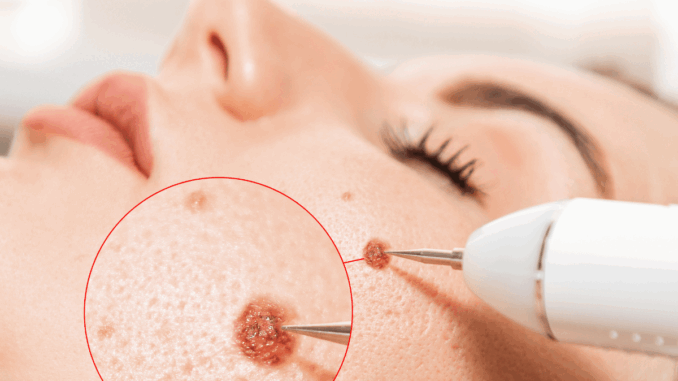

Most people have multiple moles—typically anywhere between 10 and 40—and they don’t all look or behave the same. One common type is the intradermal nevus, a mature mole that often appears as a soft, raised bump on the skin.
While these are usually harmless, knowing what’s normal—and what’s not—can help you spot changes early.
In This Content
What Is an Intradermal Nevus?
An intradermal nevus forms when melanocytes (the cells responsible for skin pigment) move deeper into the dermis over time.
As these cells shift away from the surface:
- The mole loses its darker color
- It becomes flesh-toned, pink, or light brown
- It often appears raised, soft, and smooth (sometimes slightly warty)
These moles typically range from a few millimetres to about 1 cm and are commonly seen on the face, neck, and scalp, especially in adults.
How It Differs from Other Types of Moles
Moles usually evolve through stages:
1. Junctional Nevus (Early Stage)
- Flat and dark (brown or black)
- Found mostly in children and young adults
- Melanocytes sit near the skin surface
2. Compound Nevus (Intermediate Stage)
- Slightly raised with a darker center
- Common in teens and adults
- Cells exist both at the surface and deeper layers
3. Intradermal Nevus (Mature Stage)
- Raised and lighter in color
- Forms when melanocytes move entirely into deeper skin layers
- Often appears later in life
A pale, raised mole that hasn’t changed for years is typically an intradermal nevus.
Why These Moles Are Usually Harmless
Intradermal nevi are considered low-risk because the pigment cells are located deeper in the skin and are no longer highly active.
Most skin cancers, like melanoma, develop closer to the surface where cells are more exposed to UV damage.
That said, low risk doesn’t mean zero risk—which is why regular monitoring is important.
The ABCDE Rule: How to Check Your Moles
Dermatologists recommend using the ABCDE method to evaluate any mole:
- A – Asymmetry: One half doesn’t match the other
- B – Border: Irregular, blurred, or jagged edges
- C – Color: Multiple shades instead of one uniform tone
- D – Diameter: Larger than 6 mm (about a pencil eraser)
- E – Evolution: Any change in size, shape, color, or symptoms
For intradermal nevi, “E” (Evolution) is the most important. These moles should stay stable over time.
Warning Signs You Shouldn’t Ignore
Even though most raised moles are benign, certain changes should prompt a doctor’s visit:
- Sudden or rapid growth
- Darkening or uneven color changes
- Irregular or newly jagged borders
- Unexplained bleeding
- Persistent itching or tenderness
A mole that has been unchanged for years and then starts evolving needs professional evaluation.
How Dermatologists Examine Moles
Doctors often use dermatoscopy, a handheld device that magnifies and illuminates the skin to reveal patterns invisible to the naked eye.
Typical benign intradermal nevi show:
- Smooth structures
- Regular patterns
- No abnormal pigment networks
If anything looks suspicious, a biopsy may be done:
- Shave biopsy: Removes the raised portion
- Punch biopsy: Takes a small circular sample
- Excisional biopsy: Removes the entire mole
Removal Options (If Needed)
Although harmless, many people choose to remove intradermal nevi for cosmetic or practical reasons.
Common methods include:
- Shave excision: Quick, no stitches, minimal downtime
- Punch removal: Used for smaller moles, may leave a tiny scar
- Laser treatment: Suitable for confirmed benign cases (no tissue sample collected)
All are outpatient procedures done under local anesthesia, with recovery typically taking a few weeks.
Self-Checks: Your First Line of Defense
Regular self-exams help you catch changes early.
Once a month:
- Check your entire body in good lighting
- Use a mirror for hard-to-see areas
- Don’t forget your scalp, back, and feet
Taking photos of moles can help you track subtle changes over time.
An annual skin check with a dermatologist is also recommended—more often if you have many moles or a family history of skin cancer.
The Bottom Line
An intradermal nevus is a common, mature, and usually harmless mole that appears as a soft, raised bump. In most cases, it doesn’t require treatment.
However, staying aware is key.
If a mole:
- Changes in appearance
- Starts bleeding
- Develops irregular edges
…it’s time to get it checked.
Regular self-exams combined with professional evaluations ensure that even rare issues are caught early—keeping your skin health on track.